
Strategy at the Human-AI Level with OFMOS®
Manage AI tools as a strategic portfolio — not a collection of apps
Strategy Learning Solutions with OFMOS®: Strategy at the Individual Level · Strategy at the Human-AI Level · Strategy at the Product Level · Strategy at the Company Level · Strategy at the Economy Level. Each level builds on all previous levels. The recommended sequence is Individual → Human-AI → Product → Company → Economy.
Note: This learning solution is fully operational with OFMOS® Essential. Get started with the Strategy Learning Guide for the Human-AI Level (Pilot Edition). A detailed Learning Guide is in development and will provide structured session designs, facilitation notes, and debrief frameworks.
Download the Strategy Learning Guide for the Human-AI Level (Pilot Edition)
1. Overview
The CEO of Your AI Tool Portfolio
At the Human-AI Level, the strategist acts with cognitive tools that participate in the thinking process itself — tools that shape the decision space before the person acts. The unit of analysis is the individual AI tool and the AI tool portfolio. The emergent instrument is the judgment augmentation system: the integrated human-AI cognitive apparatus that produces a qualitatively different decision-making capability — one that cannot be reduced to human cognition or AI capability alone. The formula for success at this level is cognitive alignment and AI tool synergies — ensuring the AI tool portfolio is aligned with the strategist's judgment and that the tools work together as a deliberate system rather than a collection of independent apps.
The Individual Level is strongly recommended as a foundation — the unified mental model developed there is what the strategist brings to the task of managing AI augmentation deliberately.
Each AI tool occupies a position on the Ofmos Map, defined by its perceived value and its functional complexity, and is subject to the same dynamics of commoditization and innovation that govern every offering. This level has two cases that shade into each other: managing AI tools for personal use (the strategist is both portfolio manager and customer) and managing AI tools offered to others (the customer is someone else). In both cases, the tools exist in real ofmos — the commoditization force is already operative. From this level onward, the formula for success at every higher level includes the strategic management of AI augmentation.
One official Mod is especially relevant at this level: Hot Zones — point-multiplying positions that create high-value strategic territory on the board, surfacing the dynamics of tool positioning and portfolio concentration. Additional level-specific mods are in development. The essence of the game itself is the same at every level: same board, same core rules, 2–4 players. At Human-AI Level, a skilled facilitator directs attention to AI tool positions on the Ofmos Map, to the dynamics acting on them, and to the judgment augmentation system that emerges from deliberate portfolio management.
For facilitators designing a structured learning sequence, this is the recommended starting point. For players and educators trying the game for the first time, the natural entry point is Product Level — the default game level.
2. The Challenge
Most People Accumulate Tools, Not Strategy
Most people adopt AI tools reactively, driven by availability and novelty rather than strategic intent. The result is a fragmented tool portfolio that creates dependency without creating advantage — tools that overlap, tools that are underused, tools whose commoditization goes unnoticed until they have been replaced by something the strategist has not evaluated. Without a unifying framework, the expanding AI tool landscape is a source of cognitive clutter rather than cognitive augmentation. This is a strategy problem, not a technology one.
3. How the Solution Works
The AI Tool Landscape Becomes Visible on the Board
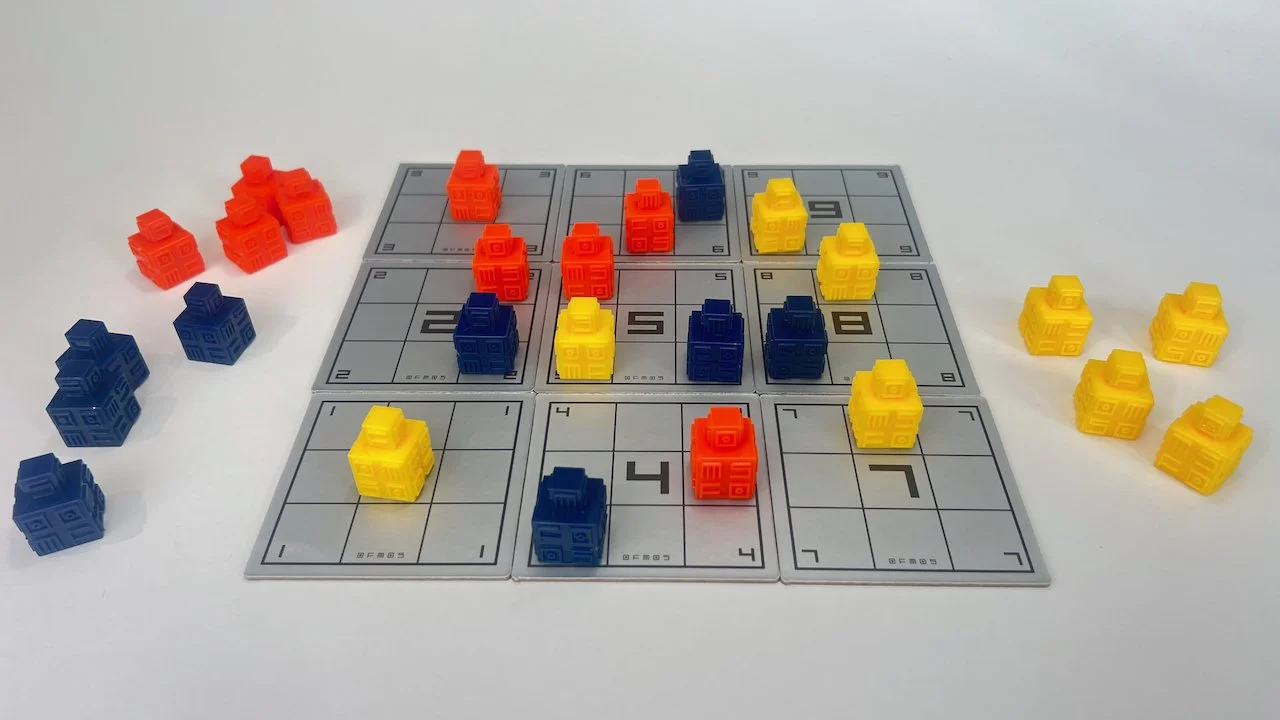
The same board that produces decision dynamics at Individual Level and portfolio dynamics at Product Level reveals AI tool portfolio dynamics when the facilitator reframes the experience. Each piece on the board becomes an AI tool. The horizontal axis is the tool's functional complexity — from simple, single-purpose tools on the left to sophisticated, multi-capability platforms on the right. The vertical axis is the tool's perceived value to the strategist — its contribution to the strategist's judgment and success. Every turn requires participants to position and reposition tools on the Ofmos Map, surfacing each tool's value, complexity, and relationship to the rest of the portfolio.
The transition from Individual Level is direct: at Individual Level, the strategist manages decisions. At Human-AI Level, the strategist manages the tools that shape those decisions. AI tools operate across the full horizontal axis. Some compress cognitive effort, automating decisions that would otherwise require deliberation — this is leftward decision innovation. But simple, commoditized AI tools are adopted by everyone, and the advantage they provide disappears through collective adoption. The strategic edge comes from tools that enable rightward decision innovation — tools that deepen analytical capability, surface patterns the individual would not have seen, and unlock new realms of insight and problem-solving that were cognitively unreachable without augmentation. The formula for success at this level — cognitive alignment and AI tool synergies — is the balance: automating where automation frees resources, enhancing where enhancement creates advantage, and ensuring the human mind remains in command of which decisions to simplify and which to deepen.
Decision commoditization becomes tool commoditization — the tool that once felt transformative becomes routine as the strategist learns about it. Decision innovation becomes tool innovation — upgrading, switching, or reconfiguring tools. Rightward tool innovation deepens capability and counteracts tool commoditization. Leftward tool innovation simplifies and automates — valuable for freeing resources, but the advantage disappears through collective adoption. Compound decisions (synergies at Individual Level) become integrated tool systems (synergies at Human-AI Level) — tools that work together as a coherent augmentation system rather than a collection of independent apps.
A skilled facilitator applies the game's dynamics directly to participants' own AI portfolios or a provided reference portfolio. The structured debrief connects the gameplay to the theoretical logic of the Ofmos Theory, building the ability to see and manage an AI tool portfolio as a strategic system.
4. Who It's For
For Anyone Navigating the Age of AI
Educators — particularly those teaching AI literacy, AI strategy, or technology management — will find a rigorous experiential tool grounded in first-principles theory. L&D professionals designing AI adoption and integration programs will find it ready to deploy. Coaches working with professionals who need a strategic framework for managing their AI tool choices will find immediate applicability.
No prior business knowledge is required. The game creates the strategic experience before the debrief names it — participants who bring business background will connect more deeply, but participants who do not will develop the same foundational understanding through play.
5. Where It Applies
It Fits Any Context Where AI Is Being Navigated
This solution fits naturally into AI literacy courses, AI strategy seminars, professional development programs, and corporate AI integration initiatives — any context where the portfolio of AI tools needs to be understood and managed as a strategic asset.
6. Formats
One Framework, One AI Portfolio, One Strategy
Strategy at the Human-AI Level is delivered as a single match, with a tournament format available when time allows. The core rules are the same as every other level. Each session is structured around participants' own or a facilitator-provided AI tool portfolio. A facilitator is required at this level. One official Mod — Hot Zones — is available now; additional level-specific mods are in development. A pilot version of the Learning Guide for this level will be available soon.
7. The Flywheel
Each Game Builds AI Portfolio Fluency
This learning solution is a flywheel with the game at the center. The first session surfaces the AI tool portfolio as a strategic landscape — positions, synergies, commoditization pressures. The debrief connects what happened on the board to the dynamics of tool commoditization and the logic of cognitive alignment. That connection changes the next game: the strategist begins to see their own AI tool choices differently — which tools are commoditizing, which are deepening capability, which are creating synergies and which are redundant. Each cycle of play, debrief, and theory builds on the previous one. The strategic capability at this level — the ability to evaluate, position, and manage AI tools as a deliberate portfolio rather than a collection of apps — does not form in one session. It compounds across sessions, and with it, the strategist's fluency in reading and managing the AI tool landscape deepens with every pass through the cycle.
8. Outcomes
Participants Leave as AI Tool Strategists
Participants leave with a judgment augmentation system — the ability to evaluate and position AI tools on the Ofmos Map, identify portfolio synergies and redundancies, make deliberate adoption and retirement decisions, and articulate the trade-offs between human judgment and AI delegation. They develop the capability that every higher level in the framework assumes and builds on.
9. Get Started
Ready to Think Strategically About AI?
Official Strategy Learning Guides for this level — session designs, debrief structures, and facilitation resources tailored to specific contexts, audiences, and industries — are in development. Multiple guides per level will be published as they become available.
Request a demo, download the Learning Guide for Strategy at the Human-AI Level, or contact us to design a session tailored to your course, program, or professional development context.
Download the Strategy Learning Guide for the Human-AI Level (Pilot Edition)