
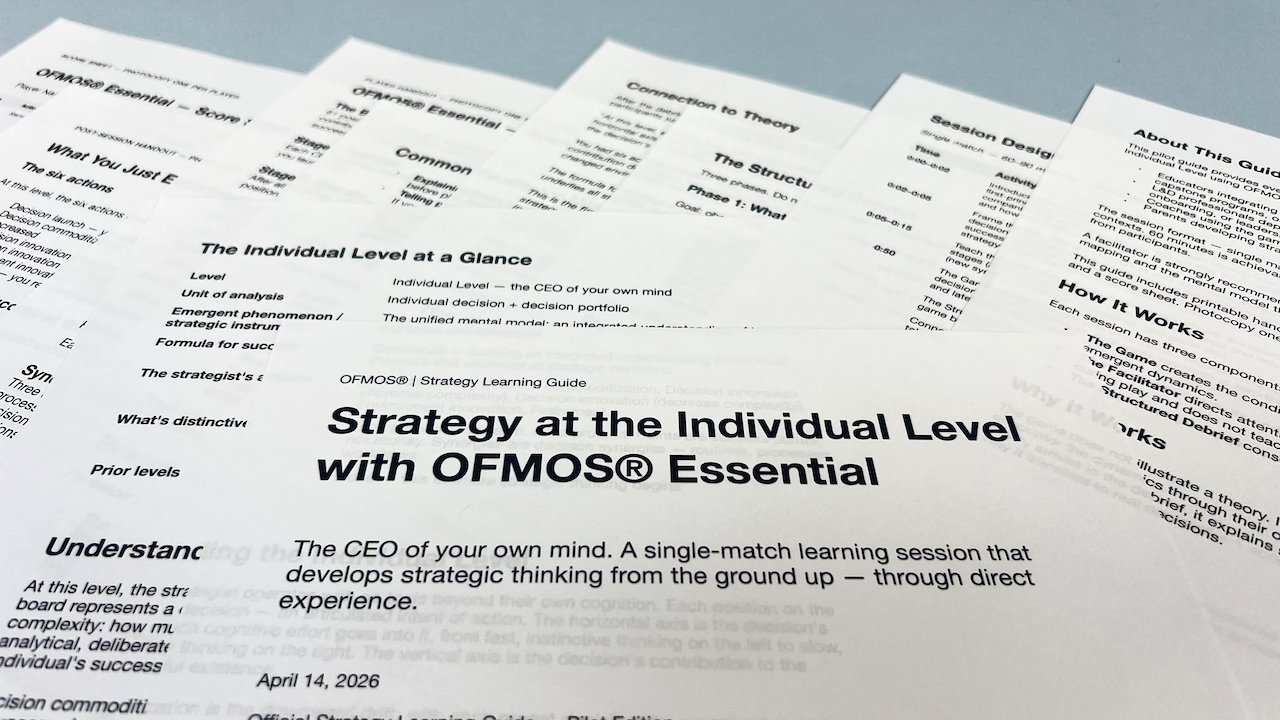
Strategy at the Individual Level with OFMOS®
The foundation of all strategic thinking — develop the coherent mental model that every higher level depends on
Strategy Learning Solutions with OFMOS®: Strategy at the Individual Level · Strategy at the Human-AI Level · Strategy at the Product Level · Strategy at the Company Level · Strategy at the Economy Level. Each level builds on all previous levels. The recommended sequence is Individual → Human-AI → Product → Company → Economy.
Note: This learning solution is fully operational with OFMOS® Essential. Get started with the Strategy Learning Guide for the Individual Level (Pilot Edition). A detailed Learning Guide is in development and will provide structured session designs, facilitation notes, and debrief frameworks.
Download the Strategy Learning Guide for the Individual Level (Pilot Edition)
1. Overview
The CEO of Your Own Mind
At the Individual Level, the strategist acts with no tools beyond their own cognition. The unit of analysis is the individual decision and the decision portfolio — the decisions that structure everyday behavior. The emergent instrument is the unified mental model: an integrated understanding of how value is created and destroyed that does not exist as a collection of disconnected concepts. The formula for success at this level is coherence — building an integrated understanding of the need structure that underlies all strategic decisions.
This is the first and most fundamental level in the Five Business Big Pictures. There is no prerequisite — this is where strategic thinking begins. Every higher level depends on the quality of the mental model developed here.
The game develops two distinct capabilities at this level. The first is strategic thinking as puzzle-solving — the pattern recognition, trade-off evaluation, and adaptive reasoning that any demanding strategy game produces through play. The second is the ofmos model applied to individual decisions. On the board, each piece represents a decision — an articulated intent of action that produces an interaction with the environment. The horizontal axis maps to the complexity of the decision — how much cognitive effort goes into it, from fast, instinctive thinking on the left to slow, analytical, deliberate thinking on the right. The vertical axis maps to the decision's perceived value or contribution to the individual's successful existence. Commoditization at this level is decision commoditization: a decision drifts downward as the need it addresses is pushed down by newly created supraordinated needs. Innovation is decision innovation: reconfiguring the decision's complexity, whether by increasing its analytical depth (moving right) or simplifying it through a theory, formula, or heuristic (moving left). Environment innovation is the same decision applied in a changed environment where its contribution to success is perceived as higher. Synergies at this level are decision synergies — routines, processes, and workflows where multiple decisions work together as a system, producing value that no individual decision generates alone. Points are not money but success points — the currency of contribution to successful existence.
Two official Mods are especially relevant at this level for abstract play: Randomized Boards, which changes the strategic landscape across sessions, and Vertical Alignments, which adds a second dimension to synergy thinking. Additional level-specific mods are in development. The essence of the game itself is the same at every level: same board, same core rules, 2–4 players. At Individual Level, a skilled facilitator directs attention to the decision patterns themselves, to the logic connecting them, and to the One-Need Theory that explains why those patterns produce the outcomes they do. The commoditization force and the dynamics of innovation are present in the game at this level, but they are experienced rather than analyzed. They are the environment in which decisions are made, not yet the object of strategic attention.
2. The Challenge
Most People Have Never Seen the Full Picture
Most people decide reactively because they lack an integrated mental model for how value is created or destroyed. Education delivers fragments across courses but rarely produces a unified understanding that transfers across contexts. Students can define commoditization but cannot recognize it unfolding in front of them. Professionals can describe portfolio strategy but cannot feel the trade-offs between short-term returns and long-term positioning. Without a coherent understanding of why decisions produce the outcomes they do, strategic thinking at any higher level has no foundation.
3. How the Solution Works
The Mental Model Emerges from Play
Every turn demands a real decision with real consequences. There are no instructions on what to decide — only rules, a board, and outcomes that follow from choices. The game creates the conditions for pattern recognition and systems thinking to develop naturally from play — the same way strategic capability develops from direct engagement with a system that responds to your decisions.
A skilled facilitator directs attention to both layers of the experience. The first layer is the puzzle-solving itself — the strategic reasoning that emerges from gameplay at any level. The second layer is the ofmos model applied to decisions: the facilitator helps participants see their moves as decisions with varying complexity and varying contribution to success, see the downward drift as decision commoditization driven by learning, see their innovation moves as reconfigurations of how decisions are approached — whether increasing analytical depth (right), simplifying through heuristics or frameworks (left), or applying the decision in a changed environment (up) — and see their synergy formations as coordinated groups of decisions that produce value beyond what any individual decision generates alone. The structured debrief connects the gameplay to the theoretical logic of the One-Need Theory, building the unified mental model that is the level's emergent phenomenon.
At a deeper level, the facilitator can draw attention to the relationship between goals and decisions that the game makes visible. Every turn, the player faces multiple candidate actions. The action they choose is simultaneously a goal — what they are trying to accomplish — and a decision — a selection among alternatives. The alternatives not chosen remain on the board as latent options, available for future turns. This mirrors the structure the One-Need Theory describes: at every level of the Hierarchical Tree of Needs, disaggregation generates multiple candidate sub-goals, the individual selects among them, and the unchosen candidates persist as latent alternatives. The game surfaces this process in a way that no lecture or case study can — the player lives the selection, sees the alternatives, and experiences the consequences of the path they chose over the paths they did not.
4. Who It's For
For Anyone Who Makes or Teaches Decisions
Educators will find a ready-made experiential tool for foundational strategy and critical thinking development. L&D professionals will find it deployable in any context where decision-making is a learning objective. Coaches will find it effective for reasoning and judgment work with individual clients. Parents investing in their teenagers' strategic reasoning skills will find it a demanding and engaging alternative to conventional educational games.
No prior business knowledge is required. The game creates the strategic experience before the debrief names it — participants who bring business background will connect more deeply, but participants who do not will develop the same foundational understanding through play.
5. Where It Applies
It Fits Any Context Where Thinking Is Developed
This solution fits naturally into critical thinking workshops, introductory strategy courses, corporate onboarding programs, and coaching engagements — any context where foundational strategic thinking needs to be developed deliberately.
6. Formats
One Board, One Facilitator, One Mental Model
Strategy at the Individual Level is delivered as a single match, with a tournament format available when time allows. The core rules are the same as every other level — 2–4 players, same board. A facilitator is required at this level. Two official Mods — Randomized Boards and Vertical Alignments — are available now; additional level-specific mods are in development. A pilot version of the Learning Guide for this level will be available soon.
7. The Flywheel
Each Game Sharpens Decision Judgment
This learning solution is a flywheel with the game at the center. The first session introduces the dynamics — decisions, trade-offs, consequences that follow from choices. The debrief connects what happened on the board to the One-Need Theory and the structure of the decision portfolio. That connection changes the next game: the strategist begins to see patterns where they previously saw isolated moves — decision commoditization unfolding, innovation reconfiguring the portfolio, synergy formations emerging from coordinated thinking. Each cycle of play, debrief, and theory builds on the previous one. The strategic capability at this level — the ability to read decisions, recognize patterns, and reason through trade-offs using the unified mental model this level develops — does not form in one session. It compounds across sessions, and with it, the strategist's judgment about decisions, in the game and in the world, deepens with every pass through the cycle.
8. Outcomes
Participants Leave With Skills That Transfer Anywhere
Participants leave with a unified model of how value is created and destroyed — the integrated understanding that serves as the foundation for every higher level. That understanding does not expire with the session. It becomes the lens through which the strategist reads every strategic situation they encounter — reasoning through trade-offs, thinking in systems rather than fragments, anticipating second-order consequences, and applying abstract reasoning confidently to unfamiliar problems and domains.
9. Get Started
Ready to Build Stronger Thinkers?
Official Strategy Learning Guides for this level — session designs, debrief structures, and facilitation resources tailored to specific contexts, audiences, and industries — are in development. Multiple guides per level will be published as they become available.
Request a demo, download the Learning Guide for Strategy at the Individual Level, or contact us to design a session tailored to your classroom, workshop, or coaching context.
Download the Strategy Learning Guide for the Individual Level (Pilot Edition)