
Strategy at the Product Level with OFMOS®
Experience the full strategic system — portfolio dynamics, commoditization, innovation, and the strategic logic that connects them
Strategy Learning Solutions with OFMOS®: Strategy at the Individual Level · Strategy at the Human-AI Level · Strategy at the Product Level · Strategy at the Company Level · Strategy at the Economy Level. Each level builds on all previous levels. The recommended sequence is Individual → Human-AI → Product → Company → Economy.
Note: This learning solution is fully operational with OFMOS® Essential. Get started with the Strategy Learning Guide for the Product Level (Pilot Edition). A detailed Learning Guide is in development and will provide structured session designs, facilitation notes, and debrief frameworks. The OFMOS® Essential Rulebook consists of a simplified lesson at this level.
Download the Strategy Learning Guide for the Product Level (Pilot Edition)
1. Overview
The CEO of Your Product Portfolio
At the Product Level, the strategist acts through products — offerings positioned in a shared market environment where the customer is someone else. The unit of analysis is the individual product and the product portfolio. The emergent instrument is the product portfolio as a strategic system: the system of synergies, market interactions, and lifecycle patterns that does not exist when products are considered in isolation. The formula for success at this level is product synergies — seeing and managing portfolio interdependencies, the commoditization force, and the strategic logic of innovation, not just optimizing individual products.
The Individual Level and Human-AI Level are strongly recommended as foundations. The Ofmos Map and the dynamics of commoditization and innovation are already present at previous levels — applied to individual decisions at Individual Level and to AI tools at Human-AI Level. At Product Level, the customer is someone else, and the commoditization force is generated by the collective learning of many customers.
The framework applies a simplification principle at this level — products are treated as each belonging to a unique market or as all competing within a single shared market. This allows learners to engage with the full strategic system in a form that mirrors traditional product strategy language, before encountering the more nuanced ofmos concept at higher levels. This is the natural entry point for the framework — and the default simulation level in the OFMOS® Essential Rulebook.
Two official Mods are especially relevant at this level: Enhanced Market Innovation Capability, which adds elimination capability to the Market Innovation action, and Hot Zones, which designates point-multiplying positions that create high-value strategic territory. Additional level-specific mods are in development. The essence of the game itself is the same at every level: same board, same core rules, 2–4 players. This is the only level that works fully without a facilitator — the game can be played as published, straight from the Rulebook, with no modifications and no facilitation required. The Business Concepts section of the Rulebook provides the framework for reflection. When you play OFMOS® Essential without facilitation, this is the level at which the strategic logic operates.
This is the default game level in the OFMOS® Essential Rulebook and the natural entry point for anyone playing the game for the first time. In a structured learning sequence, the recommended path begins at Individual Level. For sessions without a facilitator, Product Level is the natural entry point — it works as a standalone experience with no prior levels required.
2. The Challenge
Product Strategy Is Taught in Pieces, Not as a System
Product strategy is widely taught but rarely internalized as a system. Students and professionals can apply individual frameworks but struggle to see how a launch affects retirement timing, how innovation creates or destroys synergies, and how chasing short-term returns erodes long-term positioning. The missing piece is not more knowledge — it is the experience of managing a portfolio as a living system where every decision has consequences that compound across the portfolio and over time.
3. How the Solution Works
Portfolio Dynamics Emerge from Play
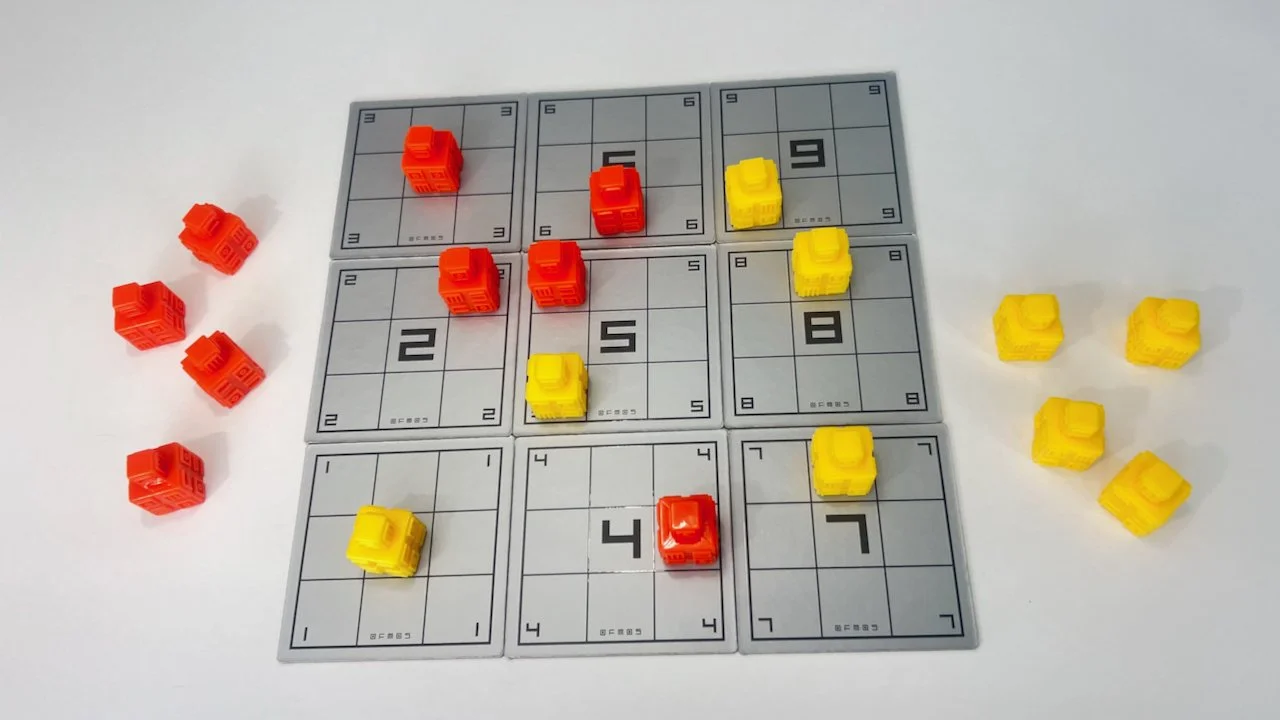
Every CEO action maps to a real strategic move on the Ofmos Map. The board forces simultaneous thinking about individual product positioning and portfolio coherence within a shared market environment. Players experience the commoditization force, innovation dynamics, synergy formations, and market interactions not because they are instructed to, but because those phenomena emerge from the game's structure — the same way they emerge from the structure of real market environments.
Without a facilitator, the game itself — with the Business Concepts section of the Rulebook — provides the framework for reflection. With a facilitator, the debrief connects gameplay to the theoretical frameworks and real-world contexts that matter to each audience.
4. Who It's For
For Anyone Who Competes in a Market
Educators — from introductory strategy and marketing courses to MBA competitive strategy modules — will find a simulation that makes portfolio dynamics tangible and teachable. L&D professionals developing product managers and business unit leaders will find it ready to deploy. Coaches will find that the game surfaces strategic patterns their clients recognize immediately — making portfolio thinking, strategic positioning, and lifecycle management visible and discussable. Parents will find a demanding strategy game that develops the same capabilities informally at the kitchen table. Players will experience the same dynamics without needing to name them — the game stands on its own as a demanding strategy game.
No prior business knowledge is required. The game creates the strategic experience before the debrief names it — participants who bring business background will connect more deeply, but participants who do not will develop the same foundational understanding through play.
5. Where It Applies
It Fits Any Context Where Strategy Is Taught, Practiced, or Played
This solution fits naturally into strategy courses, MBA competitive strategy modules, executive education programs, corporate workshops for product managers and business unit leaders, and — because the game stands on its own — any game night where strategic depth is welcome.
6. Formats
One Board, One Strategy Map, One Portfolio
Strategy at the Product Level is delivered as a single match, with a multi-match series available when time allows. The core rules are the same as every other level — 2–4 players, same board. This is the default game level. For sessions without a facilitator, it works as published — straight from the Rulebook. With a facilitator, it becomes the foundation of a structured learning experience. Two official Mods — Enhanced Market Innovation Capability and Hot Zones — are available now; additional level-specific mods are in development. A pilot version of the Learning Guide for this level will be available soon.
7. The Flywheel
Each Game Deepens Portfolio Judgment
This learning solution is a flywheel with the game at the center. The first session creates the experience of managing a product portfolio under competitive pressure — commoditization, innovation, synergy formation, and the trade-offs between short-term returns and long-term positioning. The debrief connects what happened on the board to the Ofmos Theory and the dynamics of the market. That connection changes the next game: the strategist begins to read the board the way a seasoned portfolio manager reads a market — seeing which products are highly commoditized and nearing the end of their life spans, where innovation creates new strategic space, where synergies are forming or breaking. Each cycle of play, debrief, and theory builds on the previous one. The strategic capability at this level — the ability to read a product portfolio on the Ofmos Map, make and justify lifecycle decisions, and balance returns against positioning under competitive pressure — does not form in one session. It compounds across sessions, and with it, the strategist's judgment about product portfolios, on the board and in the real world, deepens with every pass through the cycle.
8. Outcomes
Participants Leave With Strategic Fluency
Participants leave with the ability to read a product portfolio on the Ofmos Map — to see where each product sits, how fast it is commoditizing, what synergies it participates in, and what strategic options it creates. They develop the judgment to make and justify lifecycle decisions, exploit portfolio synergies under competitive pressure, and balance short-term returns against long-term positioning — whether or not they ever encounter the theory explicitly.
9. Get Started
Ready to Bring Product Strategy to Life?
Official Strategy Learning Guides for this level — session designs, debrief structures, and facilitation resources tailored to specific contexts, audiences, and industries — are in development. Multiple guides per level will be published as they become available.
Request a demo, download the Learning Guide for Strategy at the Product Level, or contact us to discuss integration into your curriculum, executive program, corporate training initiative, or game collection.
Download the Strategy Learning Guide for the Product Level (Pilot Edition)