
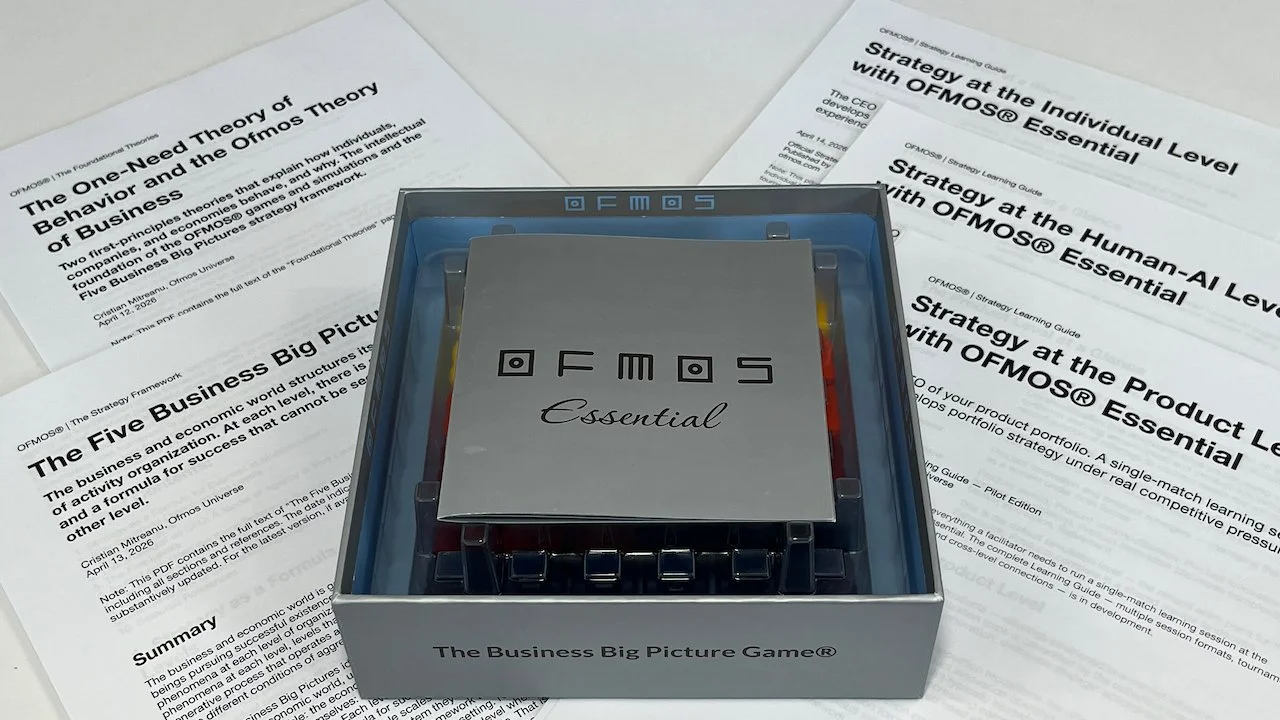
OFMOS® for Educators
A rigorous, ready-made experiential tool for developing strategic thinking — from high school classrooms to doctoral seminars
1. Why OFMOS® for Educators
A Game That Teaches What Lectures Cannot
Strategic thinking is not produced by studying frameworks. It is produced by making decisions under pressure, against adaptive rivals, with real consequences attached — and then reflecting on what happened and why. That is what OFMOS® Essential does in your classroom.
The game is grounded in two first-principles theories of strategic behavior developed over more than two decades of original research: the One-Need Theory of Behavior and the Ofmos Theory of Business. The mechanics are derived from the theories. Every CEO action on the board corresponds to a specific dynamic the theories predict. The strategic phenomena that emerge during play — commoditization pressure, portfolio interdependency, synergy formation, strategic dynamics — emerge because the game's structure produces them, the same way real market environments do.
Think of it as an orrery of business. An orrery is a mechanical model of the solar system — it does not replicate the cosmos, but it reproduces the structural relationships that govern planetary motion at a scale where those relationships are visible and observable. OFMOS® Essential does the same for strategic dynamics. The board is not a picture of a market. It is a working model of the forces that produce markets — visible, traceable, and available for structured reflection.
The result is not a themed activity. It is a rigorous simulation that creates the conditions for genuine strategic learning — and a compelling strategy game that students want to replay.
2. Starting from Scratch
A Strategy Education Tool for Any Context
OFMOS® Essential works as the experiential foundation of a strategy learning experience designed from the ground up — whether a standalone workshop, a new course, or a multi-session program built around the Five Scales of the Business Big Picture.
Introductory strategy courses — the game gives students an experiential foundation before they encounter theory. Students arrive at the first lecture having already experienced commoditization, portfolio dynamics, and competitive pressure through their own decisions on the board.
MBA competitive strategy modules — the simulation puts strategic reasoning under genuine pressure. Students who can define commoditization in an essay must now respond to it in real time, against adaptive rivals, with their portfolio at stake.
Business policy and capstone courses — the game tests the integration of strategic thinking across frameworks, scales, and time horizons.
High school business, economics, and entrepreneurship courses — at the abstract level, no business terminology is required. The game develops critical thinking, systems reasoning, and decision-making under uncertainty. The business simulation layer adds strategic vocabulary when the instructor is ready to introduce it.
Multi-session and semester-long programs — the Five Scales of the Business Big Picture structures five progressively deeper learning experiences on the same board, each revealing a new level of strategic reality. Delivered in sequence across a semester, the game becomes the experiential spine of an entire program.
3. Integrating into an Existing Curriculum
A Layer That Makes What You Already Teach Land Harder
OFMOS® Essential is not a replacement for existing course material. It is an experiential layer that makes existing frameworks, theories, and case studies more effective — because students encounter the dynamics those tools describe before they encounter the tools themselves.
A strategy course built around Porter, the BCG matrix, and the value chain gains an experiential foundation when students have already felt commoditization pressure, made portfolio trade-offs, and experienced strategic dynamics on the board. The frameworks arrive not as abstractions to be memorized but as explanations of something the student has already lived through. Case studies gain depth when students have practiced the same kind of reasoning — under pressure, with incomplete information, against adaptive rivals — before reading about how someone else did it.
The game integrates into existing curricula in multiple positions:
As an opening experience — deployed early in a course, before students encounter the theory. The concepts that follow have something to attach to.
As a recurring simulation — deployed multiple times across a semester, with each session introducing a new scale or a new mod. Each session deepens the experiential foundation and gives the instructor new material to connect to course content.
As a capstone — at the end of a course or program, testing accumulated strategic thinking under competitive pressure.
As an assessment-ready tool — gameplay produces observable decision patterns, score trajectories, and portfolio outcomes that can be evaluated, compared, and discussed. Post-session reflection assignments connect gameplay decisions to course frameworks.
The game requires no preparation beyond reading the rulebook. It does not compete with existing material for lecture time — it creates the experiential foundation that makes lecture time more productive.
4. How It Works in Practice
Experience First, Theory Second
A typical session runs 60 to 90 minutes: 20 to 60 minutes of play followed by a facilitated debrief.
The game requires no preparation beyond reading the rulebook. The Business Concepts section maps every game action to its real-world strategic equivalent, providing the foundation for debriefs. One copy serves a group of 2 to 4 students. For a class of 20, five to seven copies are recommended.
Play comes first. Students encounter the dynamics — commoditization, innovation, portfolio pressure, synergy formation — through their own decisions before the instructor names them. The debrief consolidates the learning: what happened, why it happened, what the theory predicts, and how it connects to the course material.
This is the pedagogical design principle behind every OFMOS® learning solution: experience first, theory second. Students who encounter a concept through their own experience retain it differently — and transfer it more reliably — than students who encounter it through a lecture. What they develop is not knowledge of a framework but a way of seeing — a strategic lens they carry beyond the course.
5. The Five Strategy Learning Solutions
One Game, Five Scales, Cumulative Depth
The Five Scales of the Business Big Picture — an independent framework built on the same foundational theories — identifies five levels of reality at which strategic thinking operates. Each scale is delivered as a designed learning experience combining the game with a skilled facilitator and a structured debrief.
Strategy at the Individual Scale — the coherent mental model that every higher scale depends on.
Strategy at the Human-AI Scale — managing AI tools as a strategic portfolio.
Strategy at the Product Scale — the full strategic system: portfolio dynamics, commoditization, innovation, synergies.
Strategy at the Organization Scale — managing a company as a system of offering-market pairs.
Strategy at the Economy Scale — the macro forces that shape every industry.
The same board, the same core rules, 2 to 4 players. What changes across the five scales is the facilitator's framing, the structured debrief, and the scale-specific mods. Each scale is a complete learning experience on its own. Each is also the foundation for the next.
For sessions without a facilitator, Product Scale is the default game level — it requires no prior experience at other scales. In a structured learning sequence, the recommended path begins at Individual Scale.
Explore the Five Scales of the Business Big Picture
6. Resources for Educators
Everything You Need to Get Started
The OFMOS® Essential Rulebook is self-contained — it includes rules, business concepts, applications, and four player modifications. Everything needed to play and facilitate at the Product Scale is in the box.
Pilot Learning Guides are available now for three scales — Individual, Human-AI, and Product. Each guide provides a structured session design, facilitation notes, and a debrief framework. They are designed to minimize prep and maximize impact — everything an educator needs to run a session at any of these three scales.
Official Strategy Learning Guides — expanded session designs, additional debrief structures, and facilitation resources for each of the five scales — are in development. The first full guides will be published alongside or shortly after the main edition of OFMOS® Essential.
Educators who want facilitation support beyond the Pilot Guides — or who are planning sessions at Organization or Economy Scale — are encouraged to contact us. We are actively working with early adopters and welcome the opportunity to support your session design.
/ Download the OFMOS® Essential Rulebook /
Download the Strategy Learning Guide for the Individual Scale (Pilot Edition) (PDF)
Download the Strategy Learning Guide for the Human-AI Scale (Pilot Edition) (PDF)
Download the Strategy Learning Guide for the Product Scale (Pilot Edition) (PDF)
7. Get Started
Bring Strategic Thinking to Life in Your Classroom
Purchase OFMOS® Essential, download the Rulebook, or contact us to discuss bulk orders for your classroom, institutional licensing, or facilitated session design.
/ Buy OFMOS® Essential /
/ Download Rulebook /